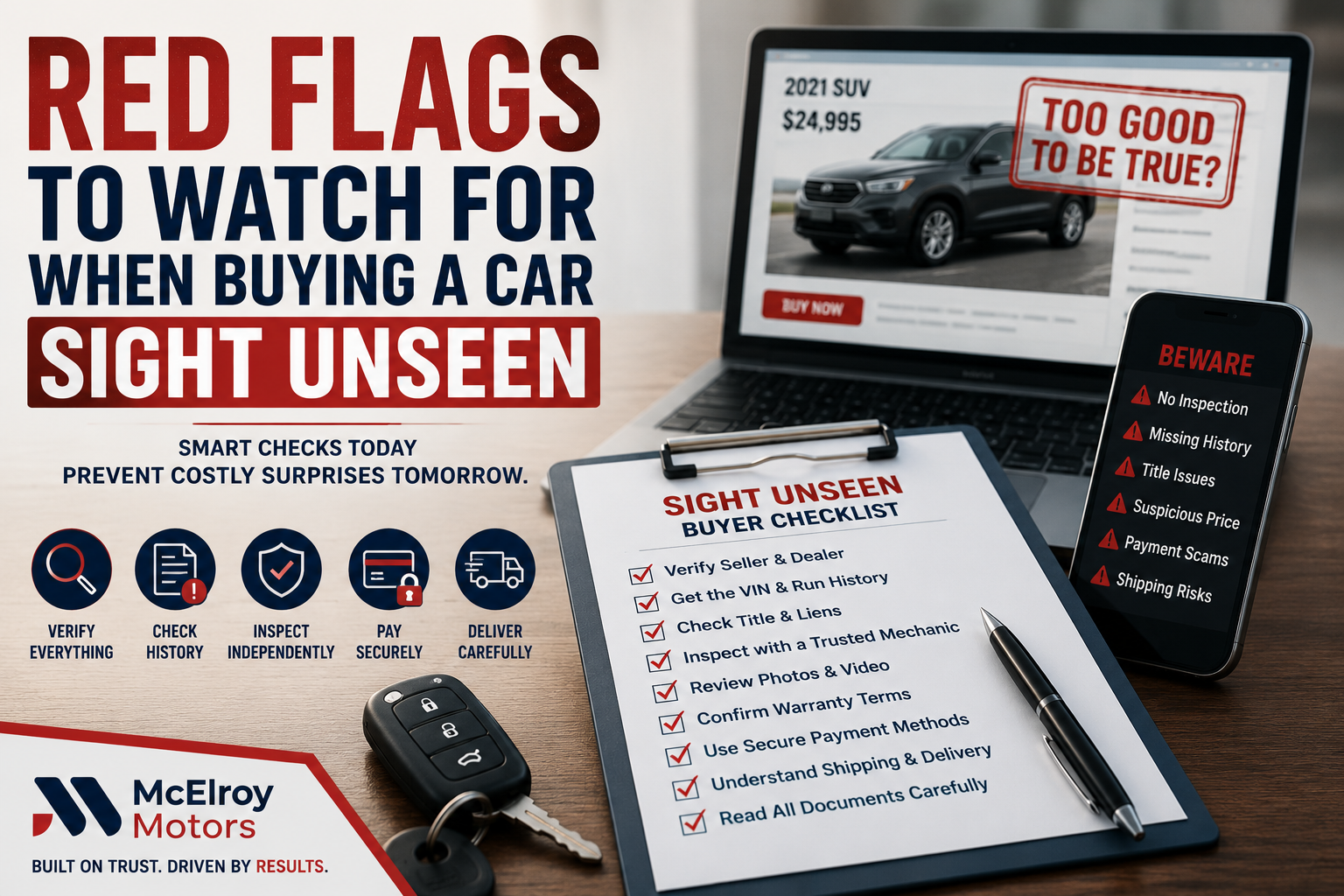
Buying a vehicle sight unseen can expand your options far beyond your local market.
You may find the exact make, model, trim, mileage, color, or price you want through an online dealership, auction, private seller, broker, or out-of-state listing. The vehicle can then be shipped directly to you or held for pickup after the transaction is completed.
That convenience also creates risk.
Photos can hide damage. Descriptions can omit important defects. Vehicle history reports may be incomplete. The seller may pressure you to send money before you have independently verified the vehicle, title, or business.
When you cannot inspect the car in person, every part of the transaction should be documented and independently confirmed.
What Does Buying a Car Sight Unseen Mean?
A sight-unseen purchase generally occurs when you agree to buy a vehicle without personally inspecting or test-driving it before payment or delivery.
This may happen through:
- An online dealership
- A dealer located in another state
- A vehicle auction
- A private online marketplace
- A wholesale transaction
- An auto broker
- A fleet liquidation
- A consignment seller
- A collector-car platform
Buying remotely is not automatically unsafe. The risk increases when the buyer relies entirely on the seller’s photographs, description, inspection, payment instructions, and shipping arrangements.
A safer transaction includes independent verification at every major step.
Red Flag 1: The Seller Refuses an Independent Inspection
One of the strongest warning signs is a seller who refuses to let a qualified mechanic inspect the vehicle.
The seller may offer explanations such as:
- The vehicle is stored in a secure facility.
- The car is too busy to be removed from the lot.
- The auction ends too soon.
- The dealership already performed its own inspection.
- Other buyers are waiting.
- The vehicle is being sold as is.
- The price is too low to allow an inspection.
None of those explanations removes the need for independent due diligence.
The Federal Trade Commission’s Buyers Guide specifically advises consumers to ask whether they may have the vehicle inspected by their own mechanic, either on or off the dealer’s lot.
For a remote purchase, hire a qualified technician near the vehicle. The inspector should work for you—not the seller—and should provide:
- Clear photographs
- Diagnostic scan results
- Fluid-condition findings
- Tire and brake measurements
- Undercarriage images
- Paint-depth or body-repair observations
- Road-test notes
- A written repair estimate
- Confirmation that the VIN matches the documents
Walk away when the seller will not cooperate with a reasonable inspection request.
Red Flag 2: The Seller Will Not Provide the VIN
A legitimate seller should be willing to provide the complete Vehicle Identification Number before requesting a deposit or payment.
The VIN allows you to:
- Confirm the exact vehicle being sold
- Review title history
- Check for theft or salvage records
- Verify specifications
- Search for open safety recalls
- Compare the VIN with listing photographs and paperwork
- Obtain an insurance estimate
- Arrange financing
Be cautious when the seller:
- Conceals part of the VIN
- Claims the VIN is confidential
- Sends a VIN that identifies a different trim or model
- Provides different VINs in separate documents
- Says the VIN will be released after payment
- Uses stock photographs that do not show the VIN plate
Ask for current photographs of the VIN displayed on the dashboard and driver-side doorjamb. Compare those numbers with the title, registration, purchase agreement, history report, and inspection report.
Red Flag 3: The Vehicle History Does Not Match the Listing
A vehicle advertised as having a clean history may have records showing prior salvage, flood, junk, insurance-total-loss, or title-brand activity.
The National Motor Vehicle Title Information System, or NMVTIS, provides consumers access to information involving title status, brand history, odometer data, theft records, and reports from insurers, junk yards, salvage yards, and recyclers.
Watch for inconsistencies involving:
- The number of prior owners
- Prior commercial or rental use
- States where the vehicle was titled
- Odometer readings
- Salvage or rebuilt branding
- Flood or fire history
- Theft recovery
- Auction announcements
- Major collision records
- Registration gaps
A history report is useful, but it is not a substitute for an inspection. Not every accident, repair, maintenance event, or ownership issue is necessarily reported to every database.
The red flag is not only a negative history. It is any significant difference between the report and what the seller represented.
Red Flag 4: The Title Is Missing, Unclear, or Not in the Seller’s Name
Do not send full payment without understanding how legal ownership will transfer.
Warning signs include:
- The seller does not have the title.
- The title is allegedly “in the mail.”
- The vehicle is titled to another person or company.
- A private seller claims to be selling for a relative or friend.
- The seller refuses to provide a title copy.
- The title contains an unresolved lien.
- The seller says a bill of sale is sufficient.
- The title brand differs from the advertisement.
- The VIN on the title does not match the vehicle.
The person or company receiving your money should have a documented legal right to sell the vehicle.
For a dealer transaction, confirm:
- The dealer’s legal business name
- Dealer-license status
- Physical address
- Whether the dealer holds or can properly reassign the title
- How liens will be satisfied
- Which documents will be delivered
- Who is responsible for registration and taxes
For a private transaction, verify the seller’s identification against the title and confirm the requirements of the states involved.
Red Flag 5: The Price Is Far Below the Market Without a Clear Reason
An unusually low price is often used to create urgency.
The seller may say:
- They are relocating immediately.
- The vehicle belonged to a deceased relative.
- They need money for an emergency.
- The car is already with a shipping company.
- The seller is deployed overseas.
- A marketplace or third party will guarantee the transaction.
- The vehicle must be sold today.
A low price may reflect a legitimate need to sell, but it may also conceal:
- Fraud
- A nonexistent vehicle
- Major mechanical problems
- A branded title
- Flood damage
- Odometer problems
- Unresolved liens
- Stolen property
- Structural damage
- Missing emissions equipment
Compare the price with similar vehicles based on year, mileage, condition, drivetrain, trim, location, and title status.
The farther the price falls below comparable listings, the more verification you should require.
Red Flag 6: The Seller Pressures You to Pay Immediately
Urgency is a common method for preventing buyers from completing due diligence.
Be cautious when the seller says:
- Another buyer is ready to pay.
- The deposit must be sent within an hour.
- The vehicle cannot be inspected until funds are received.
- The advertised price expires today.
- Shipping is already scheduled.
- The seller will only communicate by text.
- You must pay before receiving signed documents.
A legitimate remote sale may require a deposit, but the amount, refundability, and conditions should be documented.
Before paying, confirm:
- The exact vehicle
- The seller’s identity
- The title status
- The purchase price
- Taxes and fees
- Inspection rights
- Warranty status
- Delivery terms
- Refund terms
- Who bears the risk during shipping
- What happens if the vehicle differs from the description
Do not allow urgency to replace verification.
Red Flag 7: Payment Must Be Sent Through an Unusual or Irreversible Method
Exercise extreme caution when a seller insists on payment through:
- Gift cards
- Cryptocurrency
- Peer-to-peer payment sent to an unrelated person
- Wire transfer to an individual instead of the dealership
- Cash placed in the vehicle
- Prepaid debit cards
- Money transfer services
- An unfamiliar escrow company
- Multiple accounts
- A foreign bank account without a clear business reason
Scammers often prefer payment methods that are difficult to reverse or trace.
Verify payment instructions independently. Call the dealership using a phone number obtained from its official website or licensing record—not solely from an email or text containing wiring instructions.
Confirm:
- Account name
- Bank name
- Routing details
- Dealership legal name
- Invoice number
- Vehicle VIN
- Person authorized to receive funds
Email accounts can be compromised. A legitimate invoice can be intercepted and replaced with fraudulent payment instructions.
Red Flag 8: The Seller Uses a Suspicious Escrow or Shipping Company
A remote seller may claim that a third party will hold the payment and protect the transaction.
The website may appear professional but be completely fraudulent.
Warning signs include:
- The escrow company was selected only by the seller.
- The company cannot be independently verified.
- The website was created recently.
- Contact information is limited.
- The company uses a free email address.
- Payment is directed to an individual.
- The company guarantees a refund without clear written terms.
- The seller and shipping company use identical language.
- The vehicle is supposedly already in sealed storage.
- You are told the vehicle cannot be inspected before delivery.
Contact any escrow, transportation, auction, or marketplace company through independently verified channels.
Do not follow payment links supplied only by the seller.
Red Flag 9: Photographs Are Limited, Reused, or Inconsistent
A legitimate seller should be able to provide current, detailed photographs and videos.
Request images showing:
- Every exterior side
- Roof
- Undercarriage
- Wheels and tires
- Engine compartment
- Cargo area or trunk
- Interior seating
- Instrument cluster
- Odometer
- Dashboard during startup
- VIN plate
- Doorjamb label
- Keys
- Title or registration with sensitive data appropriately covered
- Existing scratches, dents, rust, and damage
Ask the seller to include a handwritten note with the current date or a specific phrase in several images. This helps confirm that the seller currently controls the vehicle and is not reusing images from another listing.
Use reverse-image search when photographs look overly polished or appear in multiple listings.
Be cautious when:
- Photos show different wheels or interiors.
- Weather or backgrounds change.
- The VIN is blurred.
- Only one side of the vehicle is shown.
- Damage areas are cropped.
- The seller refuses a live video call.
- Stock photographs are used instead of the actual vehicle.
Red Flag 10: The Seller Avoids a Live Video Walkaround
A live video call is not a replacement for a mechanical inspection, but it can confirm that the seller has access to the vehicle.
Ask the seller to show:
- The vehicle in real time
- The VIN
- Cold engine startup
- Dashboard warning lights
- Odometer
- Exterior panels
- Tires
- Engine bay
- Interior electronics
- Existing damage
- Exhaust during startup
- The vehicle moving forward and backward
Request specific actions during the call so a prerecorded video cannot easily be substituted.
Refusal to participate may indicate that the vehicle is not present, does not match the listing, or is in worse condition than represented.
Red Flag 11: The Seller Will Not Perform a Cold Start
Engine and emissions problems may be harder to detect after a vehicle has already been warmed up.
A cold start may reveal:
- Engine knocking
- Timing-chain noise
- Smoke
- Rough idle
- Hard starting
- Battery weakness
- Fluid leaks
- Dashboard warnings
- Exhaust-system problems
Ask the independent inspector to confirm that the engine was cold before starting. A warm engine when the inspector arrives may be intentional.
For diesel vehicles, a cold start can be particularly useful when assessing starting performance, smoke, glow-plug operation, fuel-system behavior, and engine condition.
Red Flag 12: Warning Lights Do Not Illuminate During Startup
Dashboard warning lights normally illuminate briefly during the startup self-check.
If the check-engine, airbag, anti-lock brake, traction-control, or other warning indicators never appear, the bulb, display, or system may have been altered.
The inspection should include:
- Startup bulb check
- Diagnostic scan
- Active codes
- Pending codes
- Permanent codes
- Recently cleared codes
- Readiness-monitor status
- Airbag-system faults
- ABS faults
- Transmission faults
A vehicle can have no visible warning light while still storing diagnostic trouble codes.
Recently reset monitors may indicate that codes were cleared shortly before the inspection.
Red Flag 13: The Seller Refuses to Share Service Records
The absence of maintenance records does not prove neglect, but it increases uncertainty.
Request documentation for:
- Oil changes
- Transmission service
- Cooling-system work
- Brake replacement
- Tire replacement
- Battery service
- Timing-belt replacement
- Diesel emissions-system service
- Recall repairs
- Collision repairs
- Major engine or transmission work
Compare the records with:
- Mileage
- Dates
- VIN
- Repair-shop information
- Vehicle history
- Manufacturer maintenance intervals
Watch for invoices with altered VINs, inconsistent mileage, missing business information, or services that do not match the vehicle.
Red Flag 14: The Seller Says a Vehicle History Report Replaces an Inspection
A clean report does not prove that the vehicle is mechanically sound.
A history report may not reveal:
- Unreported accidents
- Poor-quality repairs
- Current engine problems
- Transmission wear
- Rust
- Fluid leaks
- Flood damage that was never reported
- Electrical problems
- Worn suspension
- Recently cleared diagnostic codes
- Deferred maintenance
The FTC advises used-car buyers to obtain a vehicle history report and still have the vehicle inspected by an independent mechanic.
Treat the history report and mechanical inspection as separate parts of the review.
Red Flag 15: Open Recalls Are Minimized or Ignored
Check the VIN through NHTSA’s official recall lookup before buying.
The system identifies whether a particular vehicle has an unrepaired safety recall.
An open recall does not automatically mean the vehicle should not be purchased. You should determine:
- The nature of the safety defect
- Whether a “do not drive” or “park outside” warning applies
- Whether repair parts are available
- Which authorized dealer can complete the repair
- How long the vehicle may be out of service
- Whether the seller will complete the repair before delivery
NHTSA states that recalls do not expire, although specific repair eligibility and circumstances should be confirmed with the manufacturer.
Be cautious when the seller claims recalls are unimportant or refuses to provide the VIN for verification.
Red Flag 16: The Warranty Terms Are Vague
Do not rely on statements such as:
- “It should still be under warranty.”
- “We stand behind every vehicle.”
- “Everything is covered.”
- “You can return it if there is a problem.”
- “The manufacturer will handle it.”
Ask for the complete warranty or return policy in writing.
For dealer sales, review the FTC Buyers Guide. Covered dealers generally must display a Buyers Guide on each used vehicle offered for sale, and buyers purchasing online are also entitled to receive one. The Guide states whether the vehicle is sold as is or with a warranty and identifies important warranty terms.
Confirm:
- Warranty provider
- Covered systems
- Exclusions
- Deductible
- Repair locations
- Duration
- Mileage limit
- Claim procedure
- Transferability
- Whether preexisting conditions are excluded
- Whether the warranty is valid in your state
The FTC warns that spoken promises can be difficult to enforce. Put every material representation in writing.
Red Flag 17: The Purchase Agreement Does Not Match the Advertisement
Review the final contract before sending money or signing electronically.
Compare:
- VIN
- Year, make, model, and trim
- Mileage
- Purchase price
- Dealer fees
- Shipping charges
- Taxes
- Warranty status
- Title brand
- Included equipment
- Deposit terms
- Return rights
- Promised repairs
- Financing terms
- Trade-in allowance
Watch for:
- Newly added fees
- Optional products presented as mandatory
- Different mileage
- Incorrect VIN
- Changed warranty language
- Arbitration clauses
- Nonrefundable deposit terms
- Conditional financing
- Blank spaces
- Missing signatures
- Terms that contradict the listing
Keep copies of the listing, emails, text messages, videos, inspection report, Buyers Guide, invoice, contract, and payment records.
The CFPB recommends keeping documents and records of communications when dealing with unresolved auto dealer or lender problems.
Red Flag 18: Financing Is Not Final
A seller may tell you that financing is approved when it is still conditional.
Confirm:
- Lender name
- Annual percentage rate
- Amount financed
- Loan term
- Monthly payment
- Total of payments
- Down payment
- Whether approval is final
- Whether additional documents are required
- Whether the dealer can change terms after delivery
The CFPB advises buyers to make sure the loan and sale are final before taking possession to reduce the risk of a conditional or “yo-yo” financing problem.
You are not required to obtain financing through the dealership. Comparing quotes from banks, credit unions, and other lenders may provide better options.
Red Flag 19: Shipping Terms Are Unclear
Vehicle transport introduces another layer of risk.
Before shipment, document:
- Carrier name
- Motor-carrier information
- Insurance details
- Pickup and delivery dates
- Open or enclosed transport
- Total shipping cost
- Deposit and balance terms
- Who is responsible for damage
- Inspection procedure at pickup
- Inspection procedure at delivery
- Bill of lading requirements
- Whether personal property may remain in the vehicle
Request condition photographs immediately before loading.
At delivery:
- Inspect the vehicle before signing.
- Compare its condition with the bill of lading.
- Photograph all sides.
- Note damage in writing.
- Confirm mileage.
- Verify keys and documents.
- Do not accept verbal promises that damage will be handled later.
A shipping company should not be confused with an escrow provider or seller. Verify each party separately.
Red Flag 20: The Seller’s Identity Cannot Be Independently Verified
Before paying, confirm who is selling the vehicle.
For a dealership, verify:
- Legal business name
- Dealer-license status
- Physical address
- Official website
- Published phone number
- Business email domain
- Complaint contact
- Reviews across multiple sources
- Name on the title or reassignment documents
For a private seller, verify:
- Government-issued identification
- Name on the title
- Address
- Ownership history
- Lien-release documentation
- Signed bill of sale
Do not rely solely on:
- Social-media profiles
- Marketplace ratings
- Screenshots
- Caller ID
- Email signatures
- Copies of identification sent without verification
- A website supplied by the seller
A polished online presence does not guarantee that the person contacting you actually represents the business.
A Safer Sight-Unseen Buying Process
Use the following sequence before committing to a remote purchase.
Step 1: Verify the seller
Confirm the seller’s legal identity, address, license status, and authority to sell the vehicle.
Step 2: Obtain the VIN
Compare it across the vehicle, title, listing, history reports, inspection documents, and purchase agreement.
Step 3: Review title and vehicle history
Use an approved NMVTIS provider and other relevant sources to identify title brands, odometer concerns, theft records, salvage activity, and ownership inconsistencies.
Step 4: Check open recalls
Enter the VIN into NHTSA’s recall lookup and confirm how any unresolved recalls will be addressed.
Step 5: Request detailed current media
Obtain high-resolution photographs, a live video walkaround, cold-start video, and documentation of every disclosed defect.
Step 6: Hire an independent inspector
Use a technician who reports directly to you and has no financial relationship with the seller.
Step 7: Obtain an insurance quote
Provide the VIN and intended use to your insurance professional before completing the purchase.
Step 8: Review financing and contract terms
Confirm the final price, financing, warranty, fees, deposit terms, and delivery obligations in writing.
Step 9: Verify payment instructions
Confirm the receiving account through independently obtained contact information.
Step 10: Document shipping and delivery
Use a reputable carrier, photograph the vehicle at pickup and delivery, and note damage before signing the bill of lading.
Sight-Unseen Vehicle Buying Checklist
Before sending payment, confirm that you have:
- Verified the seller’s identity
- Confirmed dealer licensing when applicable
- Obtained the full VIN
- Matched the VIN across all documents
- Reviewed an NMVTIS vehicle history report
- Checked for open recalls
- Verified title and lien status
- Obtained current photographs and video
- Completed a live video walkaround
- Arranged an independent inspection
- Reviewed diagnostic scan results
- Confirmed maintenance history
- Reviewed warranty or as-is terms
- Received the FTC Buyers Guide for a dealer sale
- Obtained an insurance estimate
- Finalized financing
- Reviewed every fee
- Documented deposit and refund terms
- Verified payment instructions
- Confirmed shipping insurance and procedures
- Saved all advertisements and communications
When Should You Walk Away?
Do not proceed when:
- The seller refuses an inspection.
- The VIN is withheld or inconsistent.
- The title cannot be verified.
- Payment is demanded through an unusual method.
- The seller creates extreme urgency.
- Photographs appear stolen or reused.
- The vehicle history contradicts the advertisement.
- The seller refuses a live video call.
- Financing or warranty terms keep changing.
- The seller will not document promises.
- The payment recipient does not match the seller.
- Shipping or escrow companies cannot be verified.
- The purchase agreement contains unexplained changes.
- You are uncomfortable with the unanswered questions.
Walking away from a suspicious transaction is less expensive than recovering from fraud, title problems, hidden damage, or a vehicle that cannot be registered.
Buy Remotely Without Buying Blindly
Buying a car sight unseen requires more documentation—not less.
Do not allow photographs, a low price, or a seller’s confidence to replace an independent inspection, title verification, recall check, contract review, and secure payment process.
The objective is not simply to confirm that the vehicle exists. You need to verify that:
- The seller has the right to sell it.
- The vehicle matches the advertisement.
- Its condition supports the price.
- The title can be transferred.
- The purchase terms are final.
- The vehicle can be insured, registered, and safely operated.
McElroy Motors helps buyers define their vehicle needs, locate suitable options, and navigate the purchasing process with greater clarity.
Call or text: 1 (510) 592-6833
Email: motors@mcelroy-inc.com
Website: motors.mcelroy-inc.com
CA Dealer Lic. #84450
Vehicle-sale laws, title requirements, warranty protections, return rights, dealer obligations, taxes, financing rules, and registration procedures vary by state and transaction. This article provides general educational information and does not replace an independent mechanical inspection, legal advice, financing advice, or review of the applicable purchase documents.