Workers’ compensation renewal should not be treated as a routine paperwork exercise.
The information submitted during renewal—payroll, employee duties, classification codes, claims history, subcontractor records, and business changes—can materially affect the premium quoted for the next policy term.
A company may assume its workers’ compensation rate increased simply because “insurance costs are going up.” In reality, part of the increase may be tied to preventable reporting errors, unresolved claims, inaccurate classifications, or a large adjustment from the prior policy audit.
The best time to address these issues is before the renewal application reaches the underwriter.
How Is a Workers’ Compensation Premium Calculated?
Workers’ compensation pricing varies by state, insurer, industry, and employer. However, the calculation commonly begins with several core elements:
- Employee payroll
- Workers’ compensation classification codes
- The rate assigned to each classification
- The employer’s experience modification factor, when applicable
- Schedule credits or debits
- State assessments and other policy charges
- Minimum-premium requirements
- Results from the prior policy’s premium audit
Workers’ compensation rates are generally applied to each $100 of payroll. Higher-risk job classifications typically carry higher rates than lower-risk classifications because the expected frequency and severity of injuries differ by occupation.
The experience modification factor—often called the experience mod, E-Mod, or EMR—compares an eligible employer’s historical payroll and losses with the expected losses of similarly classified businesses. The resulting factor can increase or decrease the premium applied to the employer.
That means inaccurate information can affect more than one line on the application. It can alter the entire premium calculation.
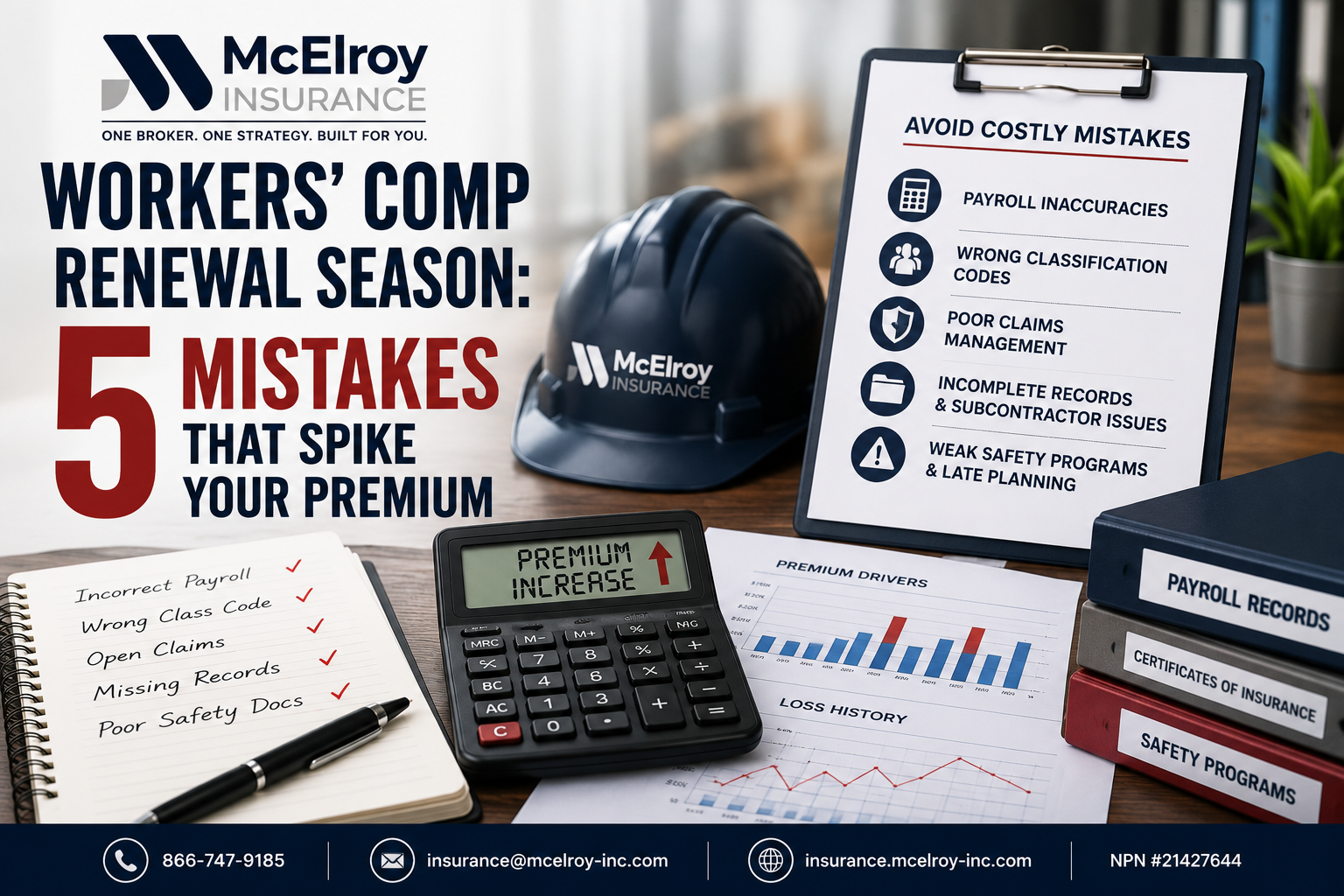
Mistake 1: Using Outdated or Unrealistic Payroll Estimates
Payroll is one of the primary drivers of workers’ compensation premium.
At the beginning of the policy term, the insurer generally calculates an estimated premium using projected payroll. At the end of the term, a premium audit compares those estimates with the company’s actual payroll and operations.
When payroll is significantly underestimated, the business may receive a substantial additional-premium bill after the audit.
For example, suppose a contractor estimates $300,000 in annual payroll but actually finishes the year with $525,000. The additional $225,000 of payroll may be added during the audit and charged using the applicable classification rates.
The company may then face two financial pressures at once:
- An audit balance from the expiring policy
- A higher estimated premium for the upcoming renewal
Premium audits are designed to confirm that the final premium reflects the actual payroll and business operations during the policy period.
Why payroll estimates become inaccurate
Payroll projections often fall behind when a business:
- Hires additional employees
- Adds overtime or bonuses
- Increases wages
- Opens another location
- Adds crews or shifts
- Wins a large contract
- Expands into a new state
- Uses more temporary labor
- Changes from subcontracted work to employee labor
- Experiences unexpected growth
Waiting until the annual audit to report these changes can create a large and unexpected adjustment. Employers should update projected payroll during the policy term when the workforce or compensation structure changes materially.
How to avoid the mistake
Review payroll by employee and job classification at least quarterly. Compare actual year-to-date payroll against the estimate shown on the policy.
Your review should include:
- Regular wages
- Overtime, where applicable under the rating rules
- Bonuses and commissions
- Paid time off
- Owner or officer payroll
- Part-time and seasonal employees
- Temporary labor
- Employees working in other states
Do not simply increase last year’s estimate by an arbitrary percentage. Base the renewal projection on current payroll reports, expected hiring, signed contracts, wage changes, and realistic business forecasts.
Mistake 2: Assigning Employees to the Wrong Classification Codes
Workers’ compensation classification codes describe the type of work being performed. Because different occupations present different injury hazards, their rates may vary substantially.
A clerical employee generally does not have the same exposure as a roofer, warehouse employee, truck driver, machine operator, or field technician.
Using the wrong classification can create several problems:
- Employees may be charged at a higher rate than necessary.
- High-risk employees may be incorrectly placed in a lower-rated class.
- The insurer may reclassify payroll during the audit.
- The business may receive a large additional-premium charge.
- The underwriter may question the accuracy of the entire submission.
- The policy may not accurately reflect the company’s operations.
NCCI’s workers’ compensation manual includes hundreds of classifications along with state-specific rules and exceptions. Classification is based on the applicable rating rules and the actual business operations—not merely the employee’s internal job title.
Job title is not enough
A company may call someone a “project manager,” but that title does not establish the correct workers’ compensation classification.
The employee might:
- Work entirely in an office
- Visit jobsites occasionally
- Supervise construction crews
- Perform hands-on labor
- Drive between customer locations
- Manage inventory in a warehouse
Those duties may lead to different classification treatment depending on the governing rules in the applicable state.
Insurers may ask for detailed descriptions of employee duties during underwriting and audit.
How to avoid the mistake
Prepare a written description for each employee group that explains:
- The work employees perform
- Where they perform it
- Whether they perform manual labor
- Whether they drive for work
- Whether they supervise field employees
- Whether they visit jobsites
- Whether their payroll is separated in the accounting system
- Whether duties changed during the policy year
Do not move employees into a lower-rated classification solely to reduce premium. The classification must be supported by actual duties and the applicable state rating rules.
Also review classifications whenever the company adds a new service. A contractor that expands from interior painting into roofing, demolition, tree work, excavation, or general construction may create a significantly different workers’ compensation exposure.
Mistake 3: Ignoring Open Claims Until Renewal
A business owner may assume that once an injured employee returns to work, the claim no longer matters.
However, an open claim may continue to carry financial reserves for future medical treatment, wage loss, legal expenses, or settlement exposure. Depending on the applicable experience-rating rules and valuation date, claim information may influence the employer’s experience modification factor and renewal pricing.
NCCI’s experience-rating system uses payroll and loss information to compare an employer’s actual loss experience with the expected loss experience of similar businesses.
This does not mean every open reserve is incorrect. It means employers should not wait until renewal to determine whether claim information is current.
Claim issues that may affect renewal
Common problems include:
- The employee returned to work, but the claim file was not updated.
- Medical treatment has ended, but the claim remains open.
- The carrier is waiting for missing payroll or wage information.
- The employer has not responded to the adjuster.
- The claim includes inaccurate facts.
- A modified-duty opportunity was never communicated.
- Duplicate or unrelated medical charges appear in the file.
- A claim that should be closed remains active.
- The loss run contains a claim the employer does not recognize.
How to avoid the mistake
Request updated loss runs well before renewal—preferably several months before the expiration date.
Review each claim for:
- Claim status
- Date of injury
- Paid losses
- Outstanding reserves
- Employee work status
- Current medical status
- Litigation status
- Subrogation potential
- Expected next steps
- Whether the claim can reasonably be closed
Communicate factual discrepancies to the insurer or claims administrator promptly. Do not demand that legitimate reserves be removed merely to reduce the premium. Instead, make sure the adjuster has accurate and current information.
A consistent return-to-work process may also reduce the duration of wage-loss claims by allowing medically capable employees to perform approved transitional duties.
Mistake 4: Keeping Poor Payroll and Subcontractor Records
Incomplete records can turn a routine premium audit into a costly dispute.
Workers’ compensation auditors may request documentation that verifies payroll, employee classifications, overtime, ownership information, subcontractor payments, and certificates of insurance.
An accurate audit depends on organized financial and payroll records. Insurers may require both a primary transaction record and a secondary document—such as a tax filing—to verify the information submitted.
Records commonly requested during an audit
Depending on the business and insurer, the audit may require:
- Payroll journals
- Quarterly payroll tax reports
- Federal tax filings
- State unemployment reports
- General ledger records
- Profit-and-loss statements
- Cash-disbursement records
- Employee rosters
- Job-duty descriptions
- Owner and officer information
- Contractor payment records
- Certificates of insurance
- Subcontractor licenses
- Temporary staffing invoices
Federal wage-and-hour rules generally require employers to preserve specified payroll records for at least three years, although workers’ compensation, tax, insurance, and state requirements may require different retention periods.
The subcontractor problem
Paying someone as an independent contractor does not automatically exclude that person from workers’ compensation exposure.
The treatment of subcontractors, uninsured contractors, sole proprietors, owner-operators, and other nonemployees depends on state law, the contractual relationship, the work performed, and the applicable policy and rating rules.
Individuals treated as contractors for business purposes may still be considered employees for workers’ compensation purposes in some circumstances.
When a business cannot produce valid evidence of workers’ compensation coverage for a subcontractor, the auditor may include some or all of the subcontractor cost as exposure, subject to applicable rules.
How to avoid the mistake
Before a subcontractor starts work:
- Obtain a current certificate of insurance.
- Confirm the workers’ compensation policy dates.
- Verify that the legal name matches the contract and invoice.
- Confirm coverage for the state where work will be performed.
- Retain the written subcontract.
- Track expiration dates.
- Request renewed evidence of coverage when necessary.
- Keep payment records separate from employee payroll.
A certificate of insurance is evidence of reported coverage at a point in time; it is not the insurance policy itself and does not independently guarantee that coverage will apply to a particular claim.
Mistake 5: Waiting Until the Renewal Deadline to Address Safety and Underwriting Concerns
Starting the renewal process a few days before expiration leaves little time to correct errors, explain claims, update payroll, resolve audits, or present evidence of improved risk controls.
Underwriters may evaluate more than the raw loss totals. They may also want to understand:
- What caused the injuries
- Whether similar incidents could happen again
- What corrective actions were taken
- Whether supervisors received training
- Whether written safety procedures exist
- Whether protective equipment is provided
- Whether employees receive job-specific instruction
- Whether the company has a return-to-work program
- Whether management tracks incidents and near misses
- Whether the company complies with applicable safety requirements
OSHA’s injury and illness recordkeeping requirements are intended to help employers identify workplace hazards and prevent future incidents.
Certain employers must maintain OSHA injury and illness records, and some establishments must electronically submit information from OSHA Forms 300, 300A, or 301. Requirements depend on factors including industry, establishment size, and applicable exemptions.
Why documentation matters
Saying “we take safety seriously” is not the same as demonstrating it.
Useful renewal documentation may include:
- Written safety policies
- Toolbox-talk records
- New-hire orientation forms
- Driver qualification procedures
- Vehicle inspection records
- Personal protective equipment logs
- Equipment maintenance schedules
- Incident investigation reports
- Corrective-action documentation
- Supervisor training records
- Return-to-work procedures
- Safety meeting attendance sheets
This information does not guarantee a lower premium. However, it gives the broker and underwriter more context than a loss run alone.
How to avoid the mistake
Begin renewal preparation approximately 90 to 120 days before the policy expiration date.
For more complex risks—such as construction, trucking, manufacturing, staffing, healthcare, multi-state operations, or businesses with significant claims—starting even earlier may be appropriate.
A Sixth Problem: Failing to Complete the Prior Premium Audit
Although this article focuses on five primary mistakes, one issue deserves separate attention: ignoring the premium audit.
Failure to complete an audit may result in estimated audit charges, noncompliance charges, policy cancellation, collection activity, or difficulty obtaining favorable renewal terms, depending on the insurer and applicable state rules.
The insurer needs the audit to calculate the final premium based on the actual exposure during the policy term. Policyholder participation may help avoid unnecessary audit noncompliance charges.
If the audit appears incorrect, do not simply ignore the bill. Request the audit worksheets and review:
- Audited payroll
- Classification assignments
- Subcontractor charges
- Officer or owner payroll
- Overtime treatment
- Multi-state allocation
- Temporary labor
- Included and excluded remuneration
- Supporting documents used by the auditor
Dispute the audit through the insurer’s formal process and provide documentation supporting the requested correction.
What Should Employers Review Before Renewal?
A workers’ compensation renewal review should include the following:
Payroll
Compare estimated payroll with actual year-to-date payroll and projected payroll for the upcoming term.
Employee classifications
Confirm that codes match current operations and actual job duties.
Business operations
Report new services, locations, vehicles, states, equipment, contracts, and ownership changes.
Claims
Review loss runs, claim status, reserves, return-to-work opportunities, and open action items.
Experience modification
Review the current experience-rating worksheet, applicable payroll data, and reported claims when the business qualifies for experience rating.
Subcontractors
Collect current certificates, contracts, licenses, and payment records.
Safety controls
Document training, inspections, incident reviews, corrective actions, and written programs.
Prior audit
Confirm that the audit has been completed and that disputed items have been addressed.
Ownership and officer information
Review included or excluded owners, corporate officers, partners, members, and payroll treatment according to state rules.
Multi-state exposure
Confirm that every state where employees live, are hired, or perform work has been reviewed. Workers’ compensation requirements and rating rules vary by jurisdiction.
Can a Clean Claims Year Still Produce a Higher Premium?
Yes.
A company can have no new claims and still receive a higher renewal premium because of:
- Increased payroll
- Higher classification rates
- A change in employee duties
- Losses from prior years entering the experience-rating calculation
- Changes to the experience-rating formula
- State assessment changes
- Reduced insurer credits
- A prior audit adjustment
- New operations or locations
- Minimum-premium requirements
- Changes in the insurance market
Premium is not determined by the current year’s claims alone.
For employers subject to experience rating, the mod is based on a multiyear period and compares the employer’s losses with the expected losses of similar businesses.
Workers’ Compensation Renewal Should Be Managed All Year
The most effective renewal strategy begins long before the application is submitted.
Accurate payroll reporting, correct classifications, timely claim communication, organized subcontractor records, and documented safety practices should be maintained throughout the policy term.
Waiting until renewal season to address these areas can lead to:
- Unexpected audit bills
- Higher estimated premiums
- Incorrect classifications
- Delayed quotes
- Limited carrier options
- Reduced negotiating leverage
- Policy cancellation or nonrenewal concerns
McElroy Insurance helps business owners prepare workers’ compensation submissions, review payroll and classification information, organize renewal documentation, and identify issues that may affect pricing.
Call or text: 866-747-9185
Email: insurance@mcelroy-inc.com
Website: insurance.mcelroy-inc.com
NPN #21427644
Workers’ compensation laws, classification rules, experience-rating plans, audit requirements, owner exclusions, benefits, and coverage obligations vary by state. This article provides general educational information and does not replace policy language, state law, rating-bureau rules, legal advice, or professional insurance guidance.